EVANGELICAL MINISTERS IN THE 1700’S
(Nonconformist to the Anglican Church)
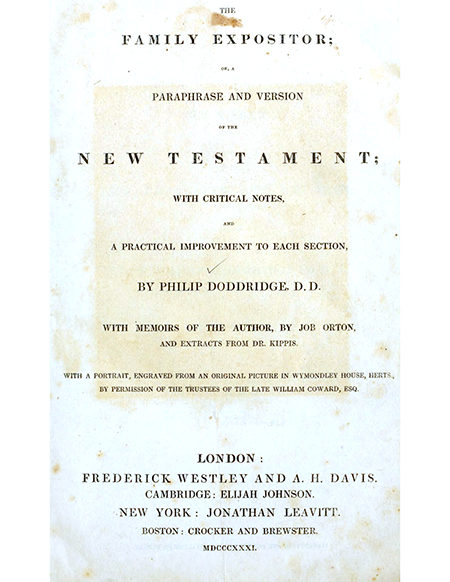
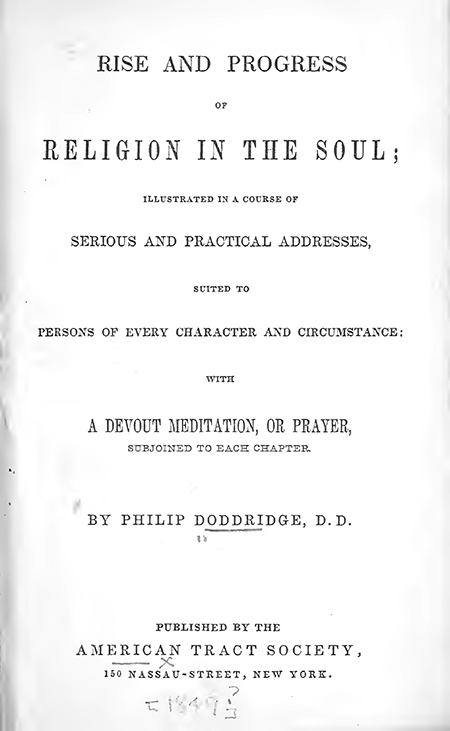
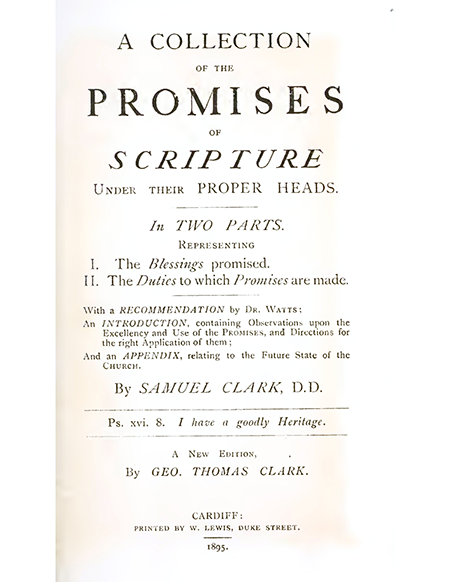
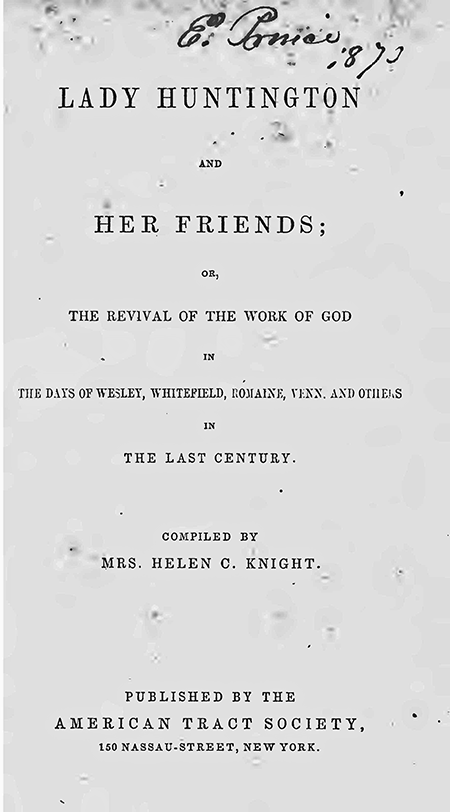
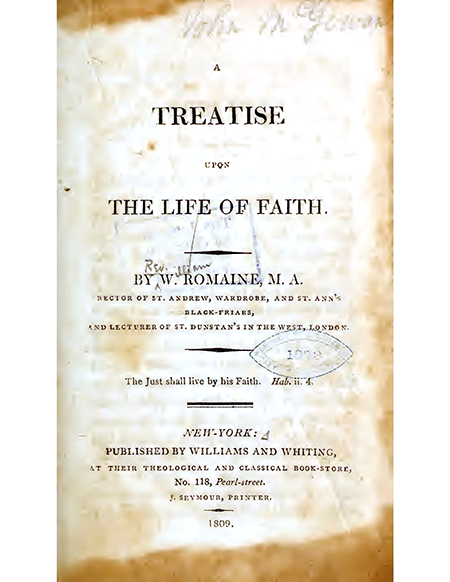
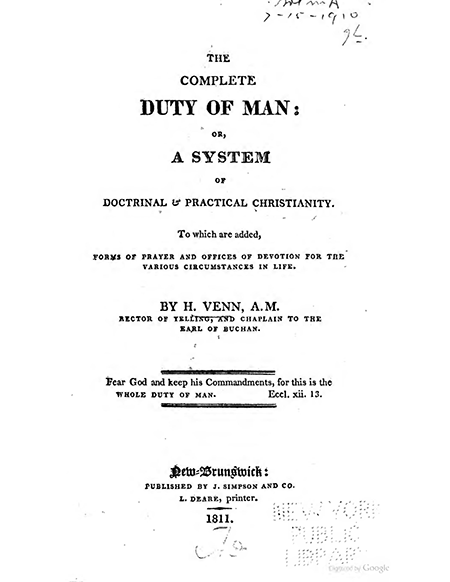
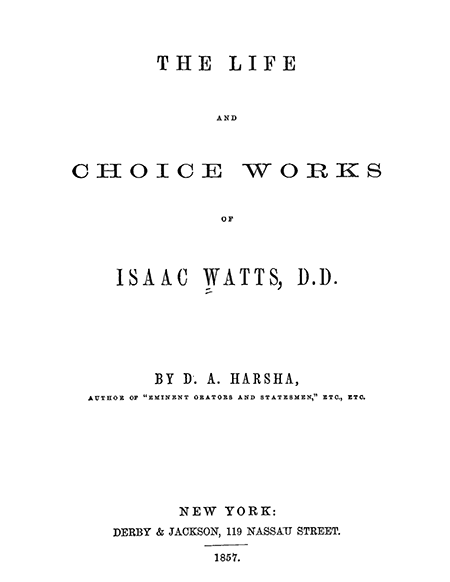
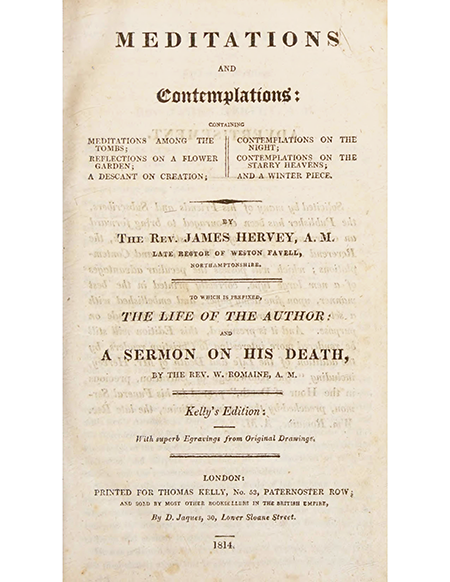
Phillip Doddridge D. D. (1702-1751), a dissenter (nonconformist), wrote, The Rise and Progress of Religion for the Soul, the book that converted William Wilberforce, an abolitionist, who was instrumental in abolishing slavery in Great Britain. He was mentored by Rev. Samuel Clarke D. D. (1675-1729), a friend of Isaac Newton & John Locke, who wrote many books and Isaac Watts (1674-1746) who was the Father of English Hymnody, composing, Joy to the World. Lady Huntington (1707-1791) played a prominent part in the religious revival of the 1700’2, financing ministers such as Wesley, Whitefield, Doddridge, Romaine, Hervey, and Venn, to name only a few, using her many estates Church services because the Anglican Church would not allow these dissenters to preach in their Churches.
*****************
** PDF Version **
About these Bibles
"These Bibles my honored grandfather Mr. John Baumann brought with him from Germany his native country, when he fled on foot from the persecution there on account of the Protestant religion. 'For he had respect to the recompense of reward/ Heb. The law of thy mouth is better to me than thousands of gold and silver.7 Psa. 119:72. 'Be ye followers of them who through faith and patience inherit the promises.' Heb. 6 : 12.”
The day of the birth of Philip Doddridge, which occurred in London on June 26, 1702, seemed for a while likely to prove also the day of his death; for the evidences of animation were so slight, and the anxious care which the mother required was so absorbing, that the infant was laid aside as dead ; but, soon afterwards, one of the attendants was providentially led to a closer examination, when a very slight early. heaving of the chest being observed, efforts at resuscitation were earnestly pursued ; and thus was saved to the world a life which proved of incalculable value.
He was his mother's twentieth child, all the others but one, and that a feeble daughter, having died Raised himself as from the grave, and expected, probably, to add another at no distant day to the sad instances of early death in the family, this only son was naturally regarded by his pious parents childhood : with especial solicitude and love. We are therefore not surprised to learn that he was most carefully trained up in the knowledge and service of Christ. Dr. Doddridge, in one of his letters, thus relates this beautiful incident connected with the period of his " I was brought up in the early knowledge of religion by my pious parents, who were in their character very worthy of their birth and education; and I well remember that my mother taught me the history of the Old and New Testaments before I could read, by the assistance of some blue Dutch tiles in the chimney-place of the room where we commonly sat; and the wise and pious reflections she made upon these stories were the means of enforcing such good impressions on my heart as never afterwards wore out."
A valuable lesson of maternal wisdom and affection is conveyed in this incident ; and with gratitude should it be considered that the means of interesting and of instructing childhood in recent years are immeasurably superior to these rude pictures, which proved so serviceable in the case of young Philip Doddridge. Having gained an elementary knowledge of the learned languages at the private school of the Rev. Mr. Scott, a pious minister in London, he was sent, at the age of ten, in 1712, to the grammar-school at Kingston upon Thames, formerly under the charge of his grandfather Baumann. Here, in the formation of his character, and in the confirmation of the religious impressions received under the paternal roof, he was greatly indebted to the kind regard and pious counsels of the Rev. Mr. Mayo, whose ministry he at tended.
Having been connected with the school in Kingston only three years, his filial love was severely tried by the death of his worthy father. The reflections which he placed on record at the time, show the resignation with which the trial was endured : " God is an immortal Father; my soul rejoiceth in him: he has hitherto helped me and provided for me ; may it be my study to approve myself a more affectionate, grateful, and dutiful child."
Great as was this affliction, he was soon called to one greater —the loss of his truly excellent mother. One of Dr. Doddridge's sermons, entitled "The Orphan's Hope” contains a touching allusion to this event: "I am under some peculiar obligations to de sire and attempt the relief of orphans ; as I know the heart of an orphan, having been deprived of both my parents at an age in which it might be reasonably supposed that a child would be most sensible of such a loss.
The orphan boy was soon removed to St. Albans, twenty miles north of London, where he attended the private school of the learned and pious Nathaniel Wood, some of whose letters will be found in the present work. While connected with this school, his conduct and attainments deserve honorable men tion. Not only was he a close student, but he took delight in assisting other students whose advantages were inferior to his own ; he conversed with them on religious subjects, and encouraged social meetings for and his walks for exercise were turned to a benevolent and pious account. Often did he call at the cottages of the poor, that he might read to them the Scriptures and other religious books, and con tribute, from his slender funds, to the supply of their temporal necessities. Thus early did he lay the foundation of those habits of practical usefulness to which his professional life was so ardently devoted while at St. Albans, that he made the acquaintance, and gained the affectionate esteem, of the Rev. Samuel Clarke,[1] the well-known author of "Scripture Promises,” whose ministry he regularly attended, with great practical benefit.
When sixteen years of age, Philip Doddridge was received into the church, of which event, and of the exercises of his mind at the time, his own interesting record has been preserved.
“I rose early this morning, and read that part of Mr. Henry's book on the Lord's supper which treats of a due approach to it. I endeavored to excite in myself those dispositions and affections which he mentions as proper for that ordinance. As I endeavored to prepare my heart according to the preparation of the sanctuary, though with many defects, God was pleased to visit me, and to give me sweet communion with himself, of which I desire always to retain a grateful sense. I this day, in. the strength of Christ, renewed my covenant with God, and renounced my covenant with sin. I vowed against every sin, and resolved carefully to perform every duty. The Lord keep this in the imagination of my heart, and grant I may not deal treacherously with him.
"In the evening I read and thought on some of Mr. Henry's directions for a suitable conversation after the Lord's supper, and then prayed, begging that God would give me grace so to act as he requires, and as I have bound myself. I then looked over the4 memorandums of this day, comparing the manner in which I had spent it, and in which I designed to spend it ; and, blessed be God, I had reason to do it It was among the richest blessings of his lot, with some pleasure, although I found cause for humiliation.”
Soon after making this public profession of relig ion, he resolved to devote himself to the service of God in the work of the Christian ministry, in the prosecution of which design he bestowed unusual care upon the study of the learned languages, and wrote comments on a portion of Scripture every morning and evening. He also committed to writing an abstract of every sermon which he heard, and added reflections of his own.
Not far had he proceeded in this course of prepa ration for the ministry, when Providence seemed to interpose an insurmountable obstacle. The property left to him by his parents was utterly lost by the failure of an unfaithful guardian, so that he found himself without the means of prosecuting his studies. It was a severe disappointment, but years afterward he regarded it as one of the most beneficent arrangements of Providence for his spiritual well-being and usefulness. To provide for this emergency he went to London, that he might consult with his brother-in law, the Rev. John Nettleton, and with Mrs. N , his beloved sister. The Duchess of Bedford in some way becoming acquainted with the young man’s embarrassments, made him, while in the city, the liberal offer to educate him at either of the Universities, provided he would leave the Dissenters, and connect himself with the Established church. To a youth ardently devoted to learning, and singularly apt in its acquisition, the trial was great, as his conscience forbade his subscription to all the articles and formularies he would be required to adopt. Over a regard to ease, to honor, and to wealth, his conscientiousness prevailed. He resolved to struggle with all the difficulties of the case, entertaining the hope that he might meet with encouragement from some of his dissenting brethren. One of the most eminent of that class of ministers was applied to for aid. The response was sufficiently discouraging. "I wait says the modest youth, "upon Dr. Edmund Calamy, to beg his advice and assistance, that I might be brought up a minister, which has always been my great desire. He gave me no encourage ment in it, but advised me to turn my thoughts to something else. It was with great concern that I received such advice; but I desire to follow providence, and not to force it. The Lord give me grace to glorify him in whatever station he sets me: then here am I; let him do with me what seemeth good in his sight."
It is possible that the discouragement of his design by Dr. Calamy may have proceeded from a view of the great delicacy of young Doddridge's constitution, "which at this period was evinced by a tall and sin gularly slender form, combined with that languid fulness of the eye, and mantling flush upon the cheek, which are too frequently the heralds of premature dissolution." In consequence of the discouragement now incurred, he turned his attention to the study of the law, having received a lucrative proposal from a celebrated counsellor in London.
Here again was offered a strong inducement to turn aside from his long cherished design of becoming a humble minister of the gospel. Wealth and honor beckoned him on in the new path thus unexpectedly opened to his ardent mind. But to this new impulse he did not hastily commit himself; he sought counsel of God, and of an enlightened con science. One of his letters relates to the interesting result:
"Before I returned my final answer, I took one morning solemnly to seek of God direction; and so it was, that even while I was thus engaged, the post man called at the door with a letter from Mr. Clarke, in which he told me that he had heard of my difficulty, and offered to take me under his care, if I chose the ministry upon Christian principles, and there were no other that in those circumstances could invite me to such a choice. This I looked upon almost as an answer from heaven; and while I live I shall ever adore so seasonable an interposition of divine Providence.”
This generous provision was offered by his be loved pastor at St. Albans; in respect to which, John Stoughton, in the discourse he delivered in Doddridge's pulpit at Northampton, a century after his death, very properly observes:
"Next to the honor of a successful ministry itself, is the distinction of being instrumental in the introduction of another to such a course; and the story of Doddridge should be regarded as a caution to the masters of our Israel, not hastily to repress, in the bosom of a gifted and ingenuous young man, aspirations after the holiest of all employments. What a loss would the church have sustained at that critical period, had not Dr. Calamy's repulse been neutralized by Mr. Clarke's encouragement?"
To this good and generous man Dr. Doddridge in after-life often expressed his obligations, and at length, in pronouncing a funeral discourse upon him, he observes, "I may properly call him my friend and father, if all the offices of paternal tenderness can merit that title. To him I may truly say that, under God, I owe even myself, and all my opportunities of public usefulness in the church —-to him, who was not only the instructor of my childhood and youth in the principles of religion, but my guardian when a help less orphan, as well as the generous, tender, faithful friend of all my advancing years.”
(Taken from MEMOIR OF THE LIFE, CHARACTER, AND WRITINGS OF PHILIP DODDEIDGE, D. D. WITH A SELECTION FROM HIS CORRESPONDENCE. By Rev. James R. Boyd, A. M.)
[1] Samuel Clarke (11 October 1675 – 17 May 1729) was an English philosopher and Anglican priest. He is considered the major British figure in philosophy between John Locke, Isaac Newton and George Berkeley Clarke's.
|